Starting Application…
Application Error
Unknown Error
The Ultimate APA Citation Generator (7th Edition) | CitationMachine.site
Streamline Your Academic Success with Precision Referencing
Mastering the nuances of academic writing shouldn’t be a hurdle to your success. Our Free APA Citation Generator is a sophisticated tool designed to help students, researchers, and professionals instantly create accurate citations. We have fully integrated the official 7th Edition of the American Psychological Association guidelines, ensuring that every comma, italicized title, and hanging indent in your bibliography meets the highest scholarly standards.
What Exactly is an APA Citation?
In the world of academia, an APA citation is a formal system of credit. It allows you to build upon the ideas of others while maintaining professional integrity. Developed by the American Psychological Association, this style is the mandatory standard for disciplines such as psychology, education, nursing, social sciences, and business.
The Three Pillars of Proper Attribution
- Preventing Plagiarism: Plagiarism, or “kidnapping” another’s work, can be illegal and lead to severe academic penalties; citations are the primary defense against these risks.
- Building Scholarly Credibility: Using properly cited, high-quality information proves to your professors and peers that you have conducted exhaustive and responsible research.
- Aiding Future Research: Your reference list serves as a roadmap, providing full publication details so readers can locate the original sources for their own studies.
How to Use the CitationMachine.site Tool
Our generator is built for speed without sacrificing accuracy. Follow this descriptive three-step process to build your bibliography:
- Identify and Select Your Source Type: Whether you are citing a peer-reviewed journal, a YouTube video, a government report, or a classic book, select the appropriate category from our menu.
- Input Source Data: Enter a URL, DOI (Digital Object Identifier), or ISBN. Our tool will “autocite” by scanning global databases to find authors, dates, and titles for you.
- Review and Export: Verify the pulled information, make any necessary manual adjustments, and click “Generate.” You can then copy the citation directly into your “References” page.
Detailed APA 7th Edition Formatting Guide
The 7th edition, released in 2020, introduced several student-friendly updates. Here is a deep dive into the two core citation types you will need:
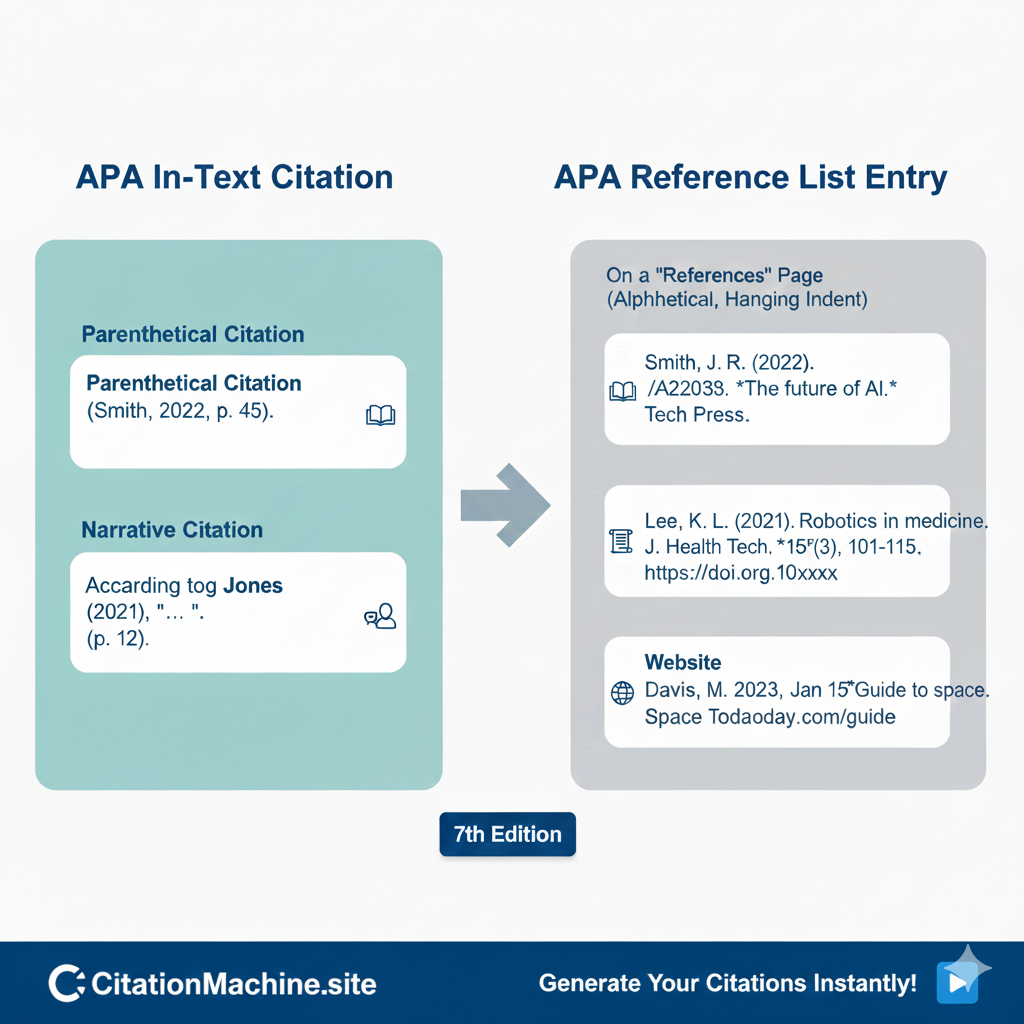
1. In-Text Citations (Narrative vs. Parenthetical)
In-text citations link a specific idea in your paper to the full source in your bibliography. They are required for direct quotes, paraphrased summaries, and general mentions of other works.
- Parenthetical Citations: These are placed at the end of a sentence before the period. They include the author, year, and page number for quotes. Example: (Tóibín, 2009, p. 52).
- Narrative Citations: Here, the author’s name is part of the sentence flow, with the year immediately following in parentheses. Example: According to Kent and Giles (2017), technology is vital….
- Multiple Authors: For three or more authors, use “et al.” starting with the very first citation. Example: (Smith et al., 2023).
2. The Final Reference List
This is the complete list of every source cited in your paper, located on its own page at the very end.
- Header: Title the page References in bold and center it at the top.
- Hanging Indents: The first line of a reference is flush-left, while all subsequent lines must be indented 0.5 inches.
- Alphabetical Order: Sources must be alphabetized by the first author’s last name.
- Double Spacing: Every entry on the page must be double-spaced.
| Source Type | Descriptive Reference Structure |
| Print Books | Last Name, F. M. (Year). Title of book (Edition). Publisher. |
| Journals with DOI | Author, A. A. (Year). Title of article. Journal Title, Vol(Issue), Pages. https://doi.org/xxxx |
| Web Pages | Author, A. A. (Year, Month Day). Title of page. Site Name. URL |
Advanced FAQ for Scholars
Is the publisher’s location required in APA 7?
No. The 7th edition has officially removed the requirement to include the city and state of the publisher, a major change from the 6th edition.
What is the difference between a DOI and a URL?
A DOI (Digital Object Identifier) is a permanent link that never changes, whereas URLs can break if a website is moved. APA 7 strongly prefers DOIs for all electronic journal articles.
How do I cite a source with no author?
If no individual or corporate author is listed, move the Title of the Source to the beginning of the reference entry and alphabetize by the first significant word in the title.
Do I need to include a “Retrieved from” date?
Retrieval dates are no longer necessary for most sources. They are only required if the content is likely to change frequently, such as a live Twitter feed or a Wikipedia entry.
Final Check: Plagiarism & Grammar
Before submitting, ensure your paper is flawless. Accidental plagiarism often occurs through “synonym swapping”—changing words but keeping the sentence structure the same. Always use our CitationMachine.site tools to verify your paraphrasing and grammar.