APA → Chicago
Professional Citation Style Transformer
Drop your DOCX here
Chicago Style Output
How to Convert APA to Chicago Style
Switching between citation styles can be a headache, especially when moving from the APA (American Psychological Association) style, commonly used in Social Sciences, to the Chicago (Notes and Bibliography) style, favored by historians and humanities scholars.
According to the Purdue Online Writing Lab, understanding the “core logic” of a style is the first step toward accurate conversion (Purdue OWL, 2024). While APA focuses on the “when” (date) to show the currency of research, Chicago focuses on the “who” and “where” to provide a detailed trail of evidence.
Steps to Convert APA to Chicago (Notes & Bibliography)
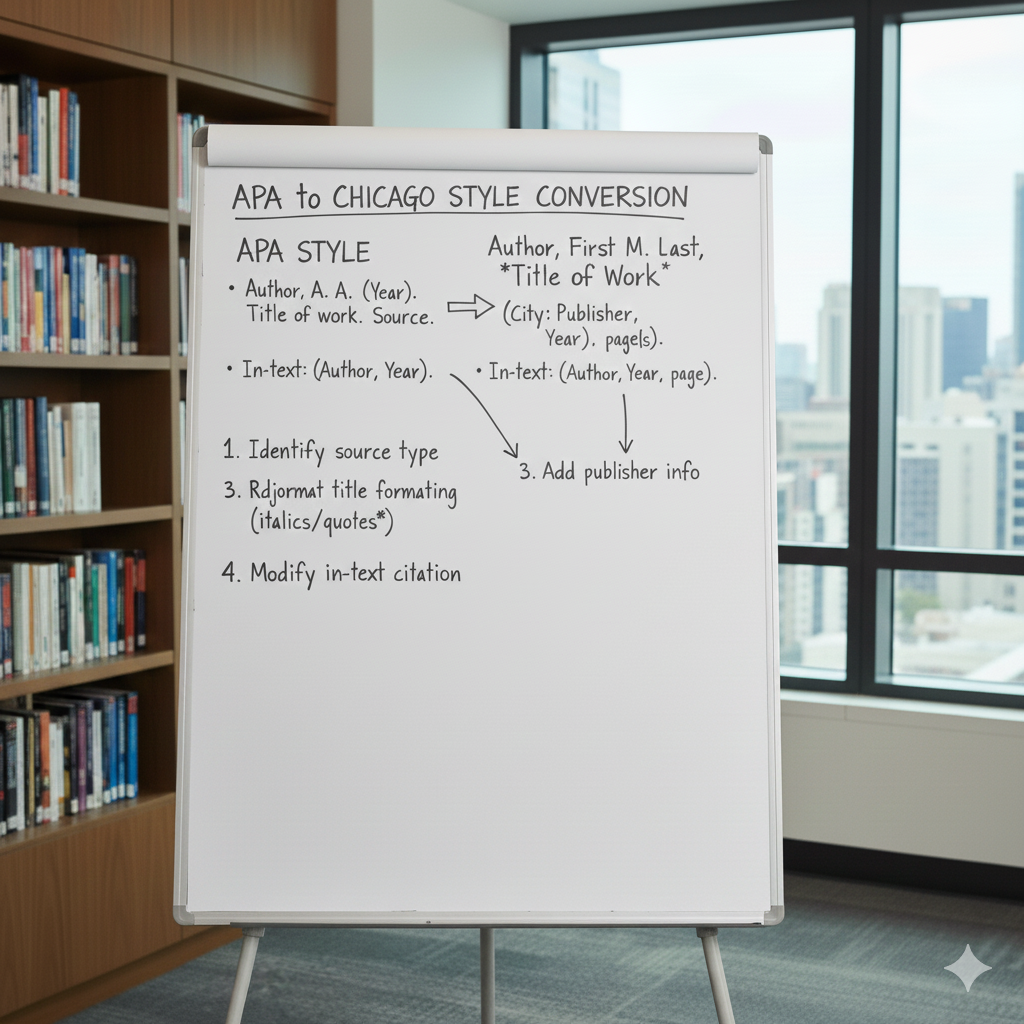
- Relocate the Date: In APA, the year follows the author in parentheses. In Chicago Bibliography style, the year moves to the very end of the citation.
- Adjust Author Names: APA uses initials for first and middle names (e.g., Smith, J. Q.). Chicago requires full names as listed on the title page (e.g., Smith, Jane Q.).
- Change Capitalization: APA uses “Sentence case” for book and article titles. Chicago uses “Title Case,” where every major word is capitalized.
- Format Titles: Ensure book titles and journal names are italicized. In Chicago, article titles are placed in “Quotation Marks,” whereas APA does not use quotes for them.
- Check for Footnotes: Remember that Chicago style usually requires footnotes or endnotes within your text, whereas APA uses in-text parenthetical citations.
Comparison Example: Book Citation
APA 7th Edition:
Hawking, S. W. (1988). A brief history of time: From the big bang to black holes. Bantam Books.
Chicago Style (Bibliography):
Hawking, Stephen W. A Brief History of Time: From the Big Bang to Black Holes. New York: Bantam Books, 1988.
Difference Table: APA vs. Chicago
| Feature | APA Style (7th Ed.) | Chicago Style (17th Ed.) |
| Author Name | Surname, Initial. (Smith, J.) | Surname, Full Name. (Smith, Jane.) |
| Date Location | Immediately after the author. | At the end of the citation. |
| Title Case | Sentence case (Only first word cap). | Title Case (All major words cap). |
| Article Titles | No quotation marks. | Enclosed in “Quotation Marks.” |
| In-text Citation | Author-Date system: (Smith, 2023). | Footnotes or Endnotes: ¹ |
| Reference List | Titled “References.” | Titled “Bibliography.” |
Quick Format Guide
APA Format:
Author, A. A. (Year). Title of book. Publisher.
Chicago Format:
Author, First Name. Title of Book. City: Publisher, Year.
Frequently Asked Questions (FAQs)
1. Can I use “et al.” in both styles?
Yes, but the rules differ. In APA, use “et al.” for three or more authors in-text. In Chicago, “et al.” is used in the Note for four or more authors, but all names are usually listed in the Bibliography (up to 10 names).
2. Is Chicago style the same as Turabian?
Essentially, yes. Turabian is a simplified version of Chicago style intended for students. The citation formats for books and articles are virtually identical.
3. Do I need to include the city of publication in Chicago?
Yes. Unlike APA 7th edition, which removed the city of publication, Chicago style (17th Ed.) still requires the location of the publisher for books.
4. How do I handle multiple authors in Chicago?
Only the first author’s name is inverted (Last Name, First Name). Subsequent authors are listed as (First Name Last Name). Example: Smith, Jane, and John Doe.
5. Does Chicago style use a “hanging indent”?
Yes. Both APA References and Chicago Bibliographies use a hanging indent (0.5 inches) where the first line is flush left and subsequent lines are indented.
6. What is the difference between Chicago “Notes & Bibliography” and “Author-Date”?
“Notes & Bibliography” uses footnotes and is common in Humanities. “Author-Date” uses parenthetical citations (similar to APA) and is used in some Physical and Natural Sciences.
7. Should I use “p.” or “pp.” for page numbers in Chicago?
In Chicago style footnotes/bibliography, you generally omit “p.” or “pp.” and simply list the numbers (e.g., Nature 171: 737–38). In APA, “p.” or “pp.” is required for book chapters or newspapers.
Reliable Citation Resources
To ensure your citations are 100% accurate, we recommend these official guides and tools:
- Official Chicago Manual of Style Online: chicagomanualofstyle.org
- Official APA Style Website: apastyle.apa.org
- Purdue Online Writing Lab (OWL): owl.purdue.edu
- Zotero: A free, open-source tool to manage and convert styles automatically. zotero.org