Starting Application…
Application Error
Unknown Error
Steps to Create a Chicago Style Citation (Book)
Follow these four steps to manually build a citation for a standard printed book:
- Author’s Name: Start with the Last Name, followed by a comma and the First Name. End with a period.
- Title of the Book: Write the full title in italics. Use title-case capitalization (capitalize all major words). End with a period.
- Publication Information: List the City of publication, a colon, the Name of the Publisher, a comma, and the Year of publication.
- Final Punctuation: Ensure the entire entry ends with a period.
Examples
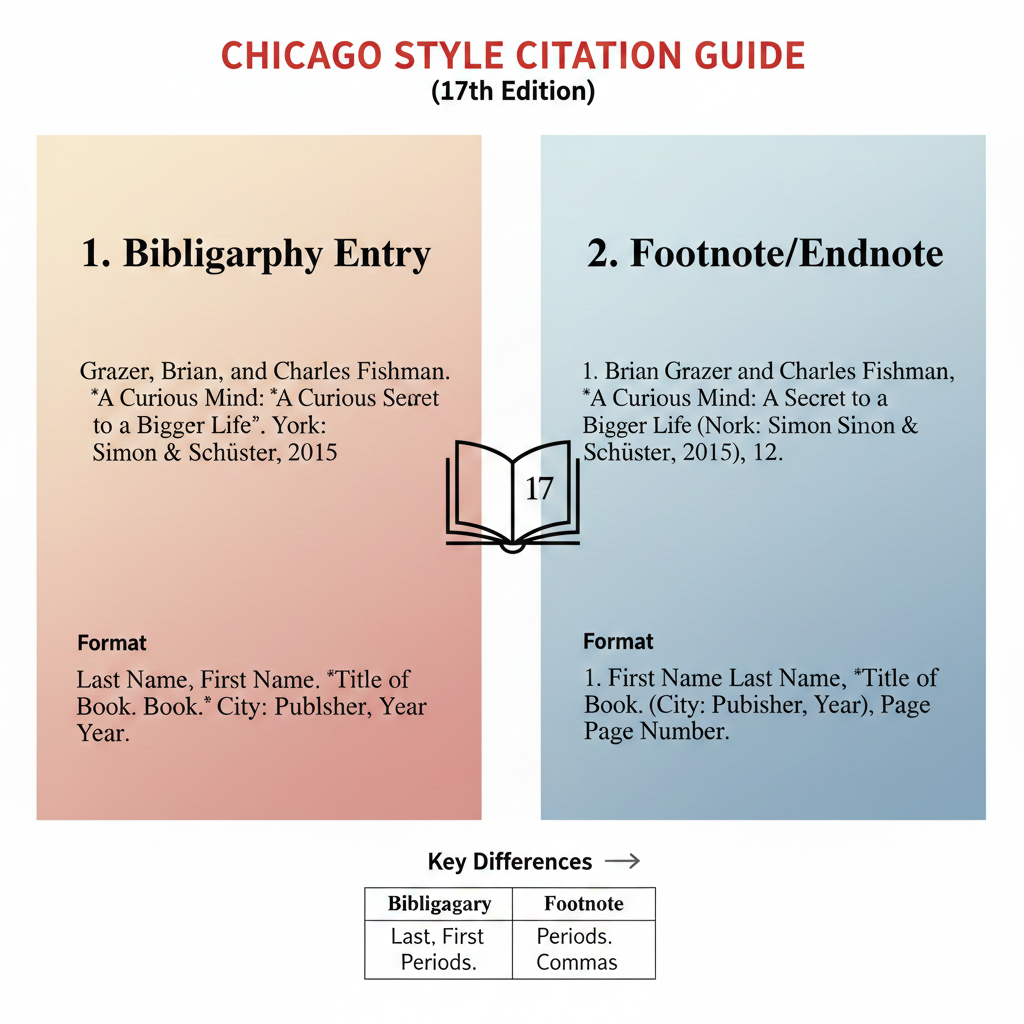
1. Bibliography Entry (For your Reference List)
This is the version you place at the end of your paper, alphabetized by the author’s last name. It uses “hanging indents” where the second line is indented.
Format: Last Name, First Name. Title of Book. City: Publisher, Year.
Example:
Grazer, Brian, and Charles Fishman. A Curious Mind: The Secret to a Bigger Life. New York: Simon & Schuster, 2015.
2. Footnote/Endnote (For In-Text Citation)
Chicago style typically uses superscript numbers in the text that lead to a note at the bottom of the page. Note that the author’s name is not inverted here.
Format: 1. First Name Last Name, Title of Book (City: Publisher, Year), Page Number.
Example:
- Brian Grazer and Charles Fishman, A Curious Mind: The Secret to a Bigger Life (New York: Simon & Schuster, 2015), 12.
Comparison of Formats
| Element | Bibliography (End of Paper) | Footnote (In-Text) |
| Author Name | Last, First. | First Last, |
| Punctuation | Uses periods to separate elements. | Uses commas and parentheses. |
| Indentation | Hanging indent (2nd line). | First line indented (like a paragraph). |
| Page Numbers | Usually not included. | Specific page cited is included. |
Importance of the Chicago Citation Style
The Chicago style is uniquely important for several reasons:
- Versatility: It offers two systems: Notes and Bibliography (preferred by humanities/history) and Author-Date (preferred by sciences/social sciences).
- Narrative Flow: By using footnotes or endnotes, Chicago style allows readers to check sources without being interrupted by parenthetical citations in the middle of a sentence.
- Depth of Information: Footnotes allow authors to provide “substantive notes”—additional commentary or context that doesn’t fit in the main text but is relevant to the research.
- Professional Standard: It is the primary style used in the American book publishing industry and by major historical journals.
Top FAQs Regarding Chicago Style
1. What is the difference between “Notes and Bibliography” and “Author-Date”?
Answer: The Notes and Bibliography system uses numbered footnotes or endnotes and a bibliography at the end. It is standard for History and the Arts. The Author-Date system uses parenthetical citations in the text (e.g., Smith 2024, 15) and a Reference list at the end. It is more common in the physical and natural sciences.
- Source: Purdue Online Writing Lab (OWL)
2. When should I use “Ibid.”?
Answer: Actually, the 17th Edition of the Chicago Manual (the most current) now discourages the use of “Ibid.” To simplify things for digital readers, they now recommend using “Shortened Citations” (Author’s Last Name, Shortened Title, Page Number) for consecutive citations of the same source.
3. How do I cite a source with more than 10 authors?
Answer: In the Bibliography, you should list all authors (up to 10). If there are more than 10, list the first 7, followed by et al. In a Footnote, you only list the first author followed by et al. if there are 4 or more authors.
4. Is a Bibliography always required?
Answer: Not always. In the Notes and Bibliography system, if you provide full publication details in every footnote the first time a source is mentioned, some instructors or publishers may not require a formal bibliography. However, in academic settings, a Bibliography is almost always expected.
Verified References for Further Research
If you are looking for the most authoritative rules, these are the “Gold Standard” websites for Chicago Style:
- The Chicago Manual of Style Online (Official Site): chicagomanualofstyle.org – The official source for all CMOS rules.
- Purdue OWL: owl.purdue.edu – The most widely used academic resource for citation examples and formatting.
- The Turabian Citation Guide: chicagomanualofstyle.org/turabian – Kate Turabian’s manual is a version of Chicago style specifically designed for student researchers.